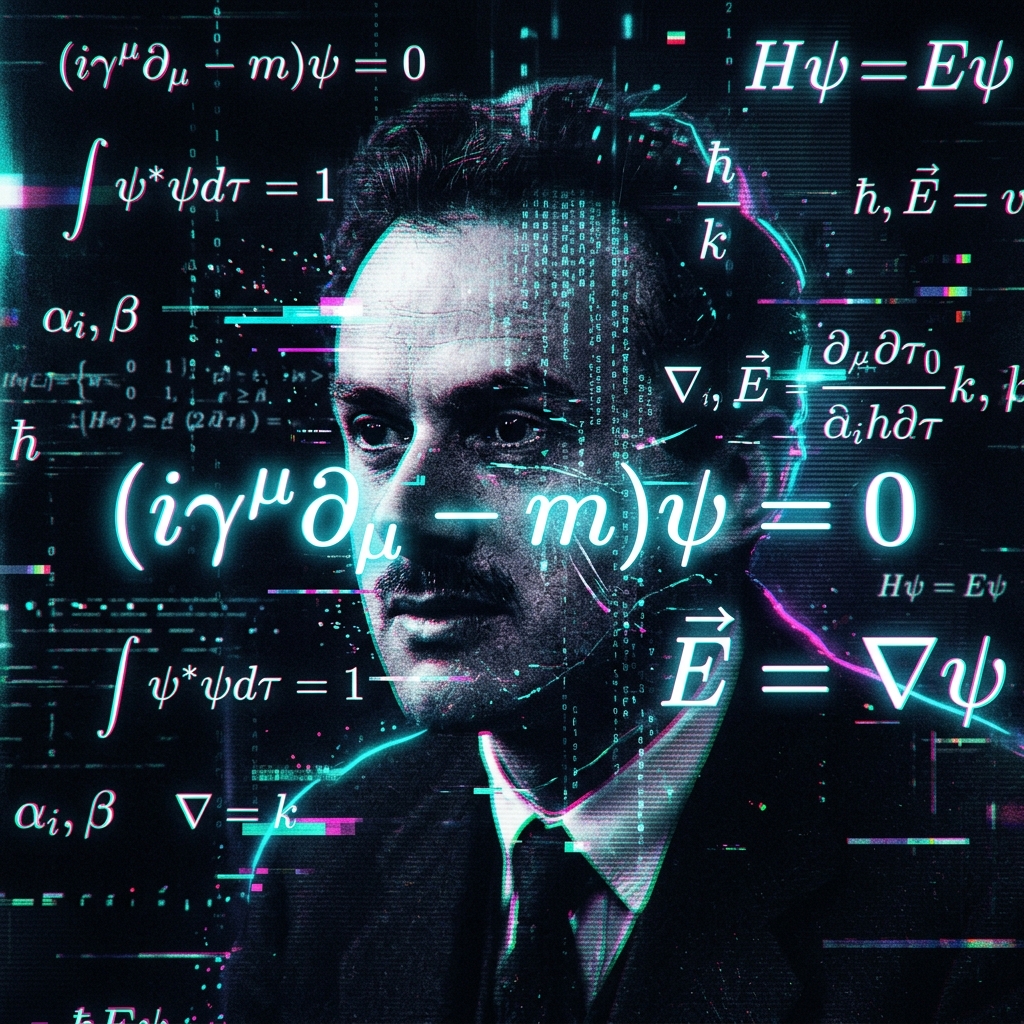
PAUL DIRAC

The Architect of the Invisible

iγμ ∂μ ψ - mψ = 0

THE DIRAC EQUATION
Paul Dirac Abstract Art

THE ANTIMATTER PROPHECY

In 1928, Paul Dirac formulated an equation that unified quantum mechanics and special relativity. It didn't just describe the electron; it predicted something entirely new: Antimatter.

QUANTUM SYMMETRY

Dirac believed that physical laws should possess mathematical beauty. His work laid the foundation for modern quantum field theory and the Standard Model of particle physics.

OTHER MAJOR CONTRIBUTIONS

1. The Dirac Equation (1928)

His masterpiece. Combined Quantum Mechanics and Special Relativity to describe fermions moving at near light-speed, mathematically explaining quantum spin.

2. Prediction of Antimatter (1931)

By taking the negative energy solutions of his equation literally, Dirac predicted the "anti-electron" (positron), birthing the entire field of antimatter physics.

3. The Dirac Sea (Hole Theory)

Proposed the universe is filled with an infinite sea of negative-energy electrons. A photon knocking an electron out creates a positive energy electron and a "hole" (positron).

4. Magnetic Monopoles (1931)

Showed mathematically that if just one magnetic monopole exists, it explains why electric charge is quantized (the Dirac quantization condition).

5. Fermi-Dirac Statistics (1926)

Discovered the statistical laws governing particles with half-integer spin (Fermions) that obey the Pauli exclusion principle.

6. Bra-Ket Notation

Invented the standard mathematical notation of quantum mechanics, splitting the inner product into a "bra" ⟨φ∣ and a "ket" ∣ψ⟩.

7. The Dirac Delta Function

Introduced δ(x), a function zero everywhere except at x=0 where it is infinite, with a total area of 1. A ubiquitous mathematical tool.

8. Early QED (1927)

Performed the "second quantization" of the electromagnetic field, effectively founding the field of Quantum Electrodynamics (QED).

9. Constrained Hamiltonian Dynamics (1950s)

Developed generalized Hamiltonian theory for systems with constraints, forming the mathematical basis for modern Gauge Theories and String Theory.

10. The Interaction Picture

Created an intermediate formulation of time evolution in quantum mechanics where both states and operators carry part of the time dependence.

11. Path Integral Inspiration (1933)

Analyzed the phase of a quantum system as it evolves through time using the classical Lagrangian, directly inspiring Richard Feynman's Path Integral formulation.